
5 min read
TV size and viewing distance: how to choose the right screen
The right TV size depends on how far you sit and what resolution you watch. Use these formulas and the table to find a comfortable, immersive fit.
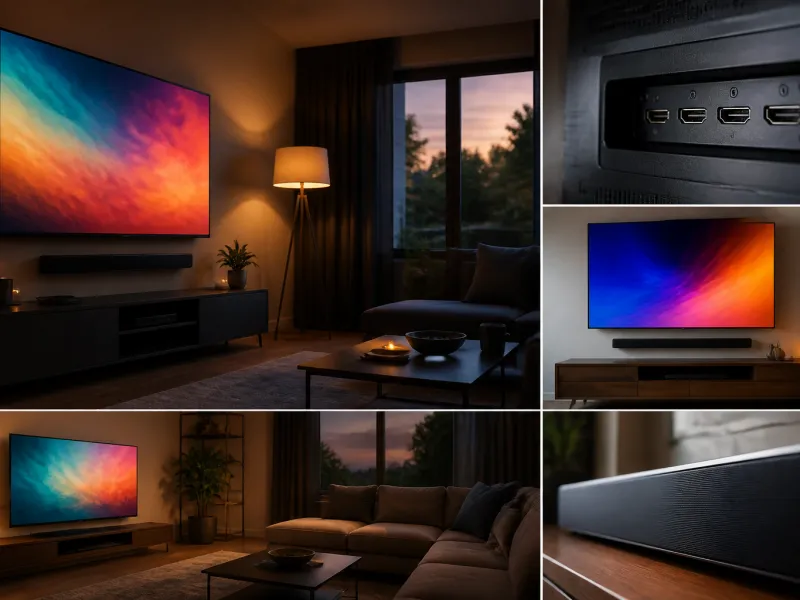
A television that is too small for the room leaves detail and immersion on the table, while one that is too large for the seating distance can make normal viewing feel uncomfortable, with visible pixels or the need to move your eyes constantly to take in the whole picture. Getting the size right is mostly a question of geometry: how far your seating is from the wall, and what resolution the content is in.
This guide gives you the formulas used to calculate a comfortable size, a ready-made distance table, and practical notes on furniture, resolution and how much immersion you actually want.
01
Why viewing distance matters
The human eye can only resolve a certain level of detail at a given distance. Sit too close to a screen and you may start to see the individual pixels or the fine structure of the image, which breaks the illusion of a smooth picture. Sit too far away and a large screen effectively behaves like a smaller one, since fine detail becomes impossible to distinguish regardless of the television's actual resolution.
The goal is to find a distance where the picture fills enough of your field of view to feel immersive, while staying far enough away that the image looks smooth and detail is not lost to the eye's limits or to compression artefacts in the source material.
 Matching productProjector screenAmazon →
02
The classic and modern formulas
For many years, the common rule of thumb for standard definition and early high definition television was to sit at a distance of about 2.5 to 3 times the screen's diagonal size. This rule was built around the resolution limits of older content and older display technology, and it produces a fairly conservative, small looking picture for a modern living room.
With 4K UHD content, which has four times the pixel count of 1080p, a closer distance no longer reveals individual pixels the way it once did, since there is simply much more detail packed into the same panel size. Most home cinema and display experts now suggest a distance of roughly 1.2 to 1.5 times the screen's diagonal for an immersive, cinema-like experience with 4K content, though many households prefer something closer to 1.5 to 2 times the diagonal for a balance between immersion and comfort during long viewing sessions.
 Matching productOLED TV 65 inchAmazon →
03
Diagonal size in centimetres and inches
Television sizes are usually advertised by their diagonal measurement in inches, for example 55 inch, with the metric equivalent in centimetres often given alongside it, for example about 139 cm. When you calculate distances, it is worth converting to a single unit throughout, since mixing inches and centimetres part way through a calculation is a common source of error. One inch equals 2.54 centimetres.
04
Suggested viewing distance table
The table below gives an approximate comfortable viewing distance range for common screen sizes, based on the 4K guidance of roughly 1.2 to 2 times the screen diagonal. Use the lower end of the range for a more cinema-like, immersive setup, and the upper end for a more traditional, relaxed living room distance.
| Screen size | Diagonal (approx.) | Comfortable distance range |
|---|---|---|
| 43 inch | 109 cm | 1.3 to 2.2 m |
| 50 inch | 127 cm | 1.5 to 2.5 m |
| 55 inch | 139 cm | 1.7 to 2.8 m |
| 65 inch | 165 cm | 2.0 to 3.3 m |
| 75 inch | 190 cm | 2.3 to 3.8 m |
| 85 inch | 216 cm | 2.6 to 4.3 m |
05
Immersion versus comfort
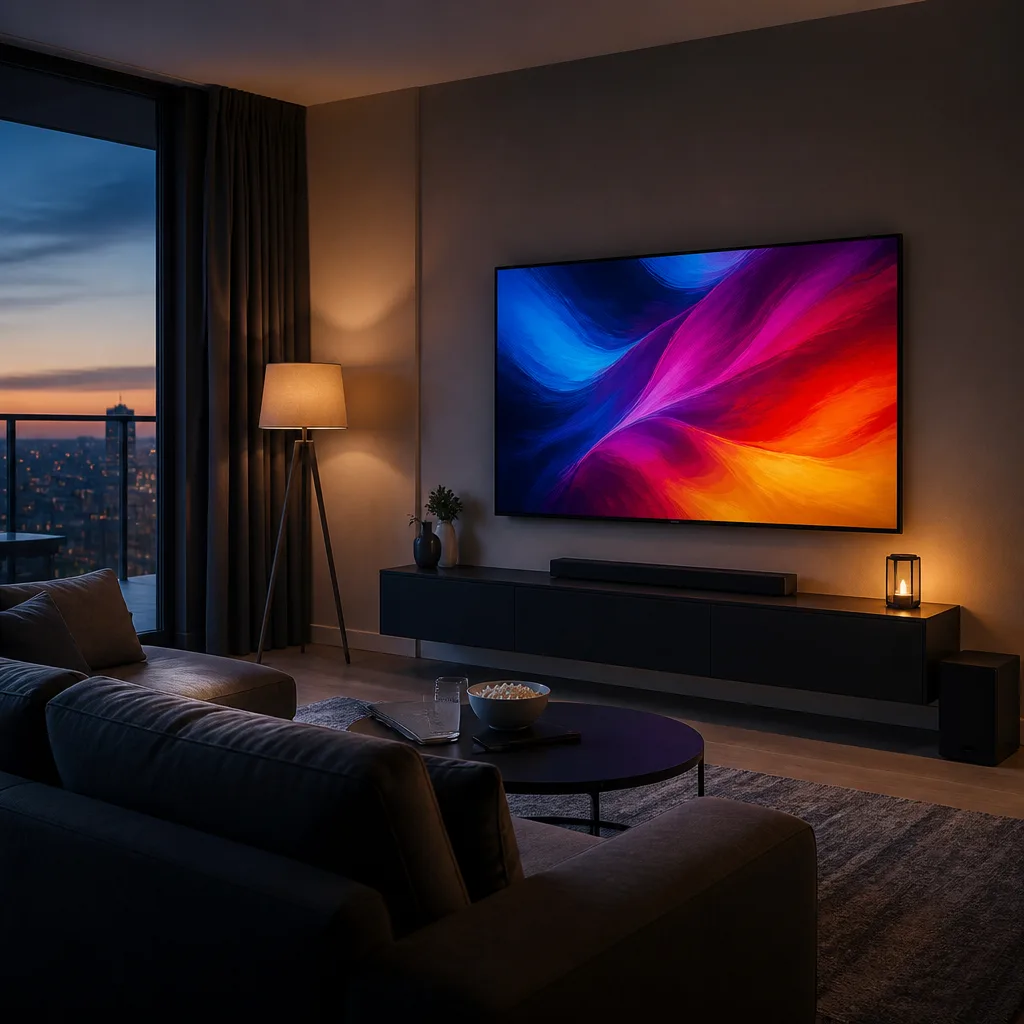
A closer, more immersive distance suits dedicated film viewing, where a wider field of view helps the picture feel like it surrounds you, similar to sitting closer in a cinema. It works particularly well in a room used mainly for focused viewing, with seating arranged directly in front of the screen.
A more relaxed distance suits rooms where the television is on for long stretches in the background, where people are also reading, working or talking, or where the seating is used for multiple purposes beyond watching television. If your household mixes both uses, choosing a size near the middle of the suggested range for your seating distance is usually the safer choice, since it avoids extremes in either direction.
06
How resolution changes the picture
The distance guidance above assumes 4K UHD content, which has a resolution of 3840 by 2160 pixels, viewed on a 4K television. Older 1080p content, or channels and sources that still broadcast in standard or high definition, contain less fine detail, so sitting close to a large 4K screen while watching lower resolution material can make compression artefacts or softness more visible than it would be with native 4K content.
This does not mean you need to sit further away when watching older content. Most modern televisions upscale lower resolution sources reasonably well. It does mean that the sharpest, most detailed result at a close distance comes from genuine 4K sources, such as many streaming services and Ultra HD Blu-ray discs, rather than from older broadcast formats.
 Matching product4K TV 50 inchAmazon →
07
Furniture and room layout considerations
The formulas above assume the television is roughly at eye level when seated and mounted straight ahead of the main seating position. A screen mounted too high, for example above a fireplace, can cause neck strain during long viewing even at an otherwise ideal horizontal distance, so consider mounting height alongside distance. Our guide to wall mounting a TV covers recommended heights in more detail.
Room shape also matters in practice. A long, narrow living room may only allow for a single realistic viewing distance regardless of the formula, in which case choosing a size that fits that fixed distance is more useful than chasing an ideal ratio. Similarly, if furniture cannot easily be rearranged, measure the actual distance from your main seat to the wall first, then use the table to find the size range that fits it, rather than choosing a size first and hoping the room accommodates it.
 Matching productTV standAmazon →
08
Measuring your own room
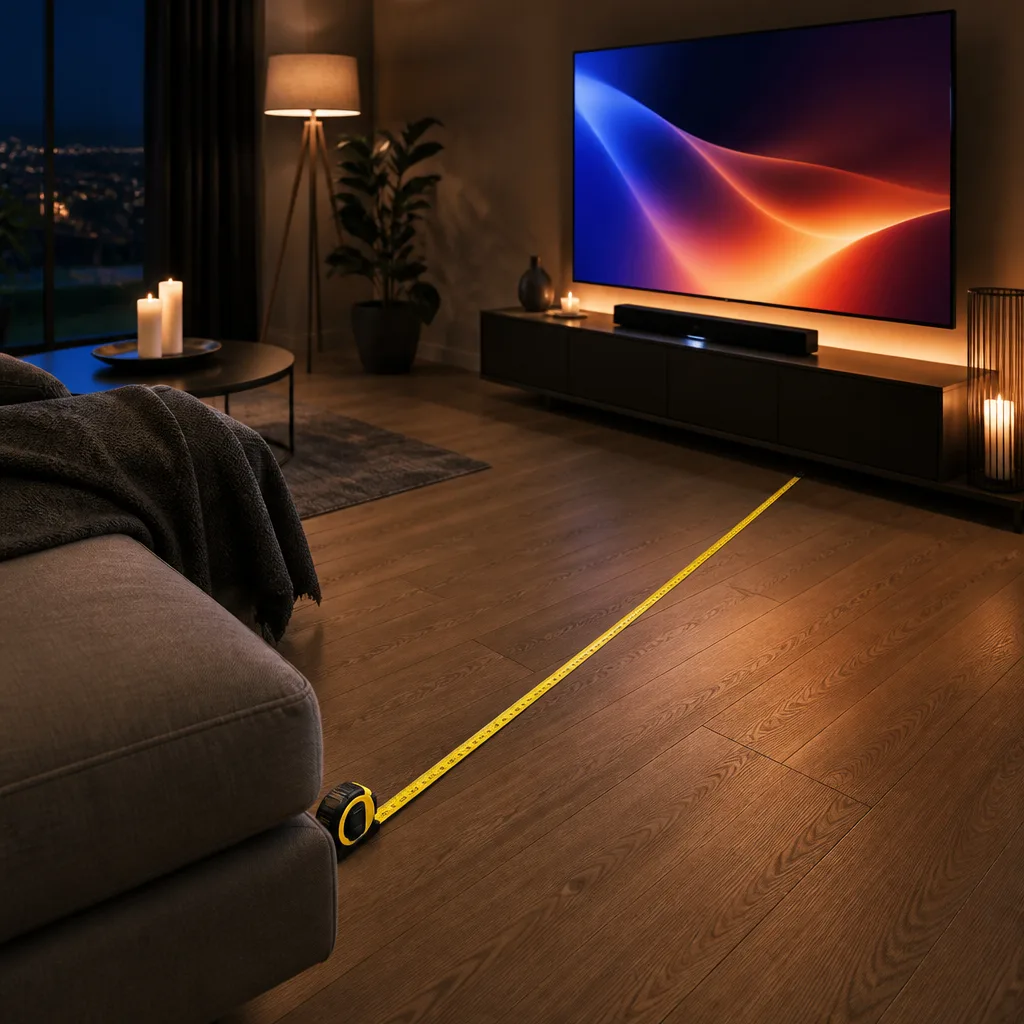
To measure your intended viewing distance, sit in your usual seat and measure the straight line distance to the wall or furniture where the television will sit, using a tape measure or a laser distance tool. Round down slightly if you are unsure, since sitting a little further than the ideal distance is generally more comfortable than sitting too close. For guidance on the wider decision, including technology and features, see our full buying guide and the TV size guide overview page.
09
Frequently asked questions
What is the simplest formula for choosing TV size
Measure your viewing distance, then divide by 1.5 for a fairly immersive result with 4K content, or by 2 for a more relaxed, traditional distance. The result, in the same unit as your measurement, gives an approximate ideal diagonal size.
Do I need a bigger TV for 4K than for 1080p
Not necessarily bigger, but 4K content supports sitting closer to a given size without seeing individual pixels, so a 4K television lets you sit closer or choose a larger size than a 1080p set would comfortably allow at the same distance.
Is it possible to sit too far from a large TV
Yes. Sitting far beyond the suggested range means fine detail becomes indistinguishable to the eye, so a large, expensive 4K panel effectively performs like a much smaller or lower resolution screen from that distance.
Should I measure in inches or centimetres
Either works, as long as you stay consistent. Television sizes are usually marketed in inches with a centimetre equivalent given alongside, for example 55 inch, about 139 cm, so convert your room measurement to match before comparing.
Explore
Read next
 TV Panel Types Explained: LCD, QLED, Mini-LED, OLED and MoreAn overview of TV panel technologies, from LCD and QLED to OLED and Micro-LED, compared on blacks, brightness, viewing angle and burn-in ri…
 TV Buying Guide: How to Choose the Right TelevisionA practical, step by step guide that walks you through every decision in buying a television, from screen size to sound.
 TV Size Guide: Screen Sizes and Viewing DistanceA practical guide to translating screen diagonal into real dimensions and choosing the right size for your viewing distance and room.